
Lumbar facet joint injection under fluoroscopy in Brussels
A lumbar facet joint injection places a medicine in the small joints of the lower back to calm low back pain. Done under fluoroscopy, it is performed on a doctor's prescription, at Saint-Guidon (Anderlecht) and Woluwe-Evere.
At a glance
- DurationVariablethe duration varies with the procedure
- PreparationTell us your treatmentsblood thinners and allergies, at the desk
- PrescriptionDoctor's requestbring it, with the medicine
- WhereSaint-Guidon and Woluwe-EvereAnderlecht, Woluwe-Saint-Lambert
- ResultReport to your doctorto review the pain together
On this page
Understanding the exam
Why a lumbar facet joint injection
The facet joints are small joints at the back of each vertebra. When they wear or become irritated, they cause low back pain: pain that often gets worse when leaning backwards, twisting or standing for long, and sometimes spreads to the buttock or thigh.
A lumbar facet joint injection places a corticosteroid, often with a local anesthetic, in or next to the joint. Your doctor suggests this back injection to calm the inflammation. The effect varies from person to person; even temporary relief also helps confirm where the pain comes from.
The procedures
Back injections
Saint-Guidon and Woluwe-Evere perform lumbar facet joint injections and sacroiliac joint injections under fluoroscopy. Other areas are on the injections page.
Lumbar facet joints
The facet joint injection in the lower back, at the level your doctor indicates. You book it online.
Sacroiliac joints
The sacroiliac joint injection, where the lower back meets the pelvis, for pain in the buttock or pelvis. You book it online.
Where
Which centers offer the injection
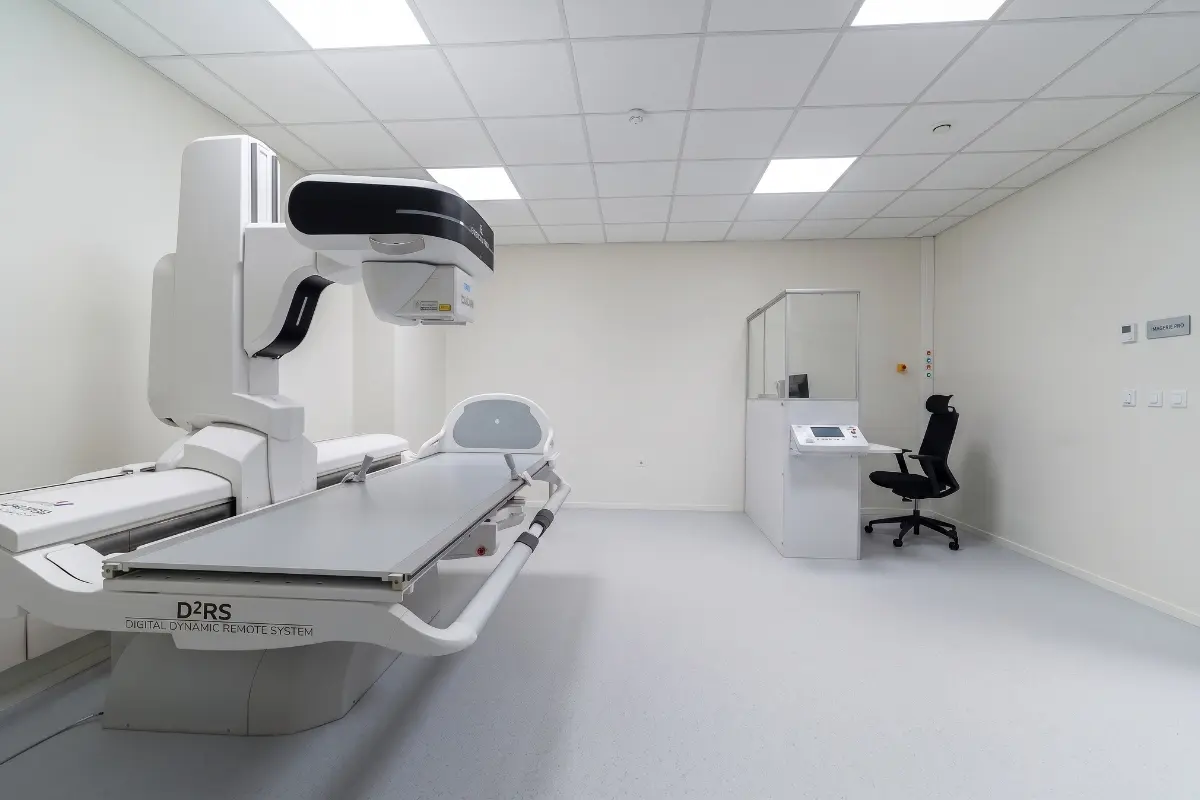
Lumbar facet joint injection is done at Saint-Guidon (Anderlecht) and Woluwe-Evere (on the border between Woluwe-Saint-Lambert and Evere), on remote-controlled tables with fluoroscopy and X-ray dose adjustment.
Book “Injection of the facet joints” in the online calendar of each center, or call +32 2 899 88 85. Addresses and directions: centers page.
Before the exam
Preparing for your injection
Bring your doctor's prescription and the medicine to be injected, supplied by a pharmacy or by our partner pharmacists; we can also get it for you on site. Bring your recent images of the back: the radiologist uses them to choose the level to treat.
Wear clothes that expose the lower back easily. Keep taking your usual medicines unless your doctor says otherwise.
Good to know. Come with someone if you can: after the local anesthetic, the lower back or leg may feel numb for a few hours.
Before the exam
Blood thinners, infection, diabetes and pregnancy
Mention these situations when you book: they change what needs to be done.
Blood thinners. Never stop them yourself: your doctor decides whether they are kept, adjusted or paused, because the needle can cause a bruise under the skin.
Infection. Fever, a wound or a red patch of skin near the back means the injection is postponed, so that no germs get in.
Diabetes. A corticosteroid can raise blood sugar for a few days: check it more often after the injection.
Allergy. Tell us about any allergy to an anesthetic, a medicine, iodine or a disinfectant.
Pregnancy. If you are pregnant or think you might be, say so before the injection: fluoroscopy uses X-rays, and the radiologist and your doctor decide together what to do.
During the exam
How the injection is done
- Reception. You hand your prescription and the medicine to the front desk.
- Setup. The technologist lays you on the remote-controlled table, usually on your front.
- Locating. The radiologist finds the joint on screen using fluoroscopy.
- Disinfection. The skin is disinfected, then numbed with a fine needle.
- Injection. The needle advances under screen control, then the medicine is injected slowly.
- Finish. A small dressing is applied and you can go home.
You mostly feel the prick of the anesthetic, then some pressure. Stay still during the procedure and tell the team right away if you feel unwell. The duration varies with the procedure.
After the exam
After the injection: report, pain and warning signs
The radiologist writes a report of the procedure for your prescribing doctor. The report is also published automatically on the Brussels Health Network and on MyHealth (Ma Santé). You review the pain together with them: note how it changes over the following weeks.
The pain can increase, sometimes strongly, for two to three days before the corticosteroid starts to work, a common reaction. Relief comes afterwards, to a varying degree. Rest on the same day and avoid strenuous effort over the next days.
Seek advice quickly for fever, very severe pain that gets worse, weakness or numbness in a leg, or trouble passing urine: these rare signs need medical attention right away.
Your imaging done at our centers stays available on PACSonWEB, with the access code given on site.
For a further work-up, see the related exams.
Your questions
Frequently asked questions about back injections
Do I need an appointment?
Yes. Waiting times are short and an appointment is often possible the same day: book in the online calendar of the center or call +32 2 899 88 85. A prescription is still required.
How many injections can I have?
Your doctor decides how often injections are given. If an injection had no effect, they consider another approach.
Is the injection reimbursed?
The prescribed procedure is covered by the INAMI/RIZIV nomenclature and the third-party payer system is applied in all our centers. For the medicine, your pharmacist tells you what is reimbursed.
Fluoroscopy or ultrasound guidance?
The joints of the back lie deep: we reach them under fluoroscopy. For the shoulder, knee or a tendon, the injection is done under ultrasound: see the injections page.
Read on
Exams related to facet joint injection
Before or after a back injection, your doctor may request one of these exams.
- Ultrasound-guided injectionShoulder, knee, hip, tendons and other areas, without X-rays.
- X-rayThe image of bones and joints: osteoarthritis, collapse, position of the vertebrae.
- MRI and CT scanOrganized by Access Imaging at our partner hospitals; our team arranges the appointment for you.
- UltrasoundImages with ultrasound, without X-rays, for tendons and joints.
Find all our exams on the exams page, the addresses on the centers page, more answers in the frequently asked questions, or write to us through the contact page.